

VO2max is finally making its way into the fitness vernacular. Social media platforms are rife with ludicrous adverts for companies claiming they can increase a person’s VO2max from 20 mL O2/Kg/min to 70 mL O2/kg/min in just four weeks. That’s like transforming a person with a body mass index of 40 who has never exercised in their life into an Olympic triathlete (so best of luck signing up for that nonsense).
In the more reliable popular press, National Geographic Magazine published an article that provides scientific data indicating that an increase in VO2max of just 1 mL O2/kg/min can reduce a person’s all-cause morbidity risk by 10%, an astounding metric that indicates VO2max is a critical factor in longevity.
It’s not surprising, given the surge of interest in VO2max, that several companies now sell instruments for measuring this parameter via breath analysis, those instruments that do it accurately being very expensive. Several smart watches also provide their owners with a (very questionable) estimation of the maximum rate at which their bodies consume oxygen—without measuring this directly, of course.
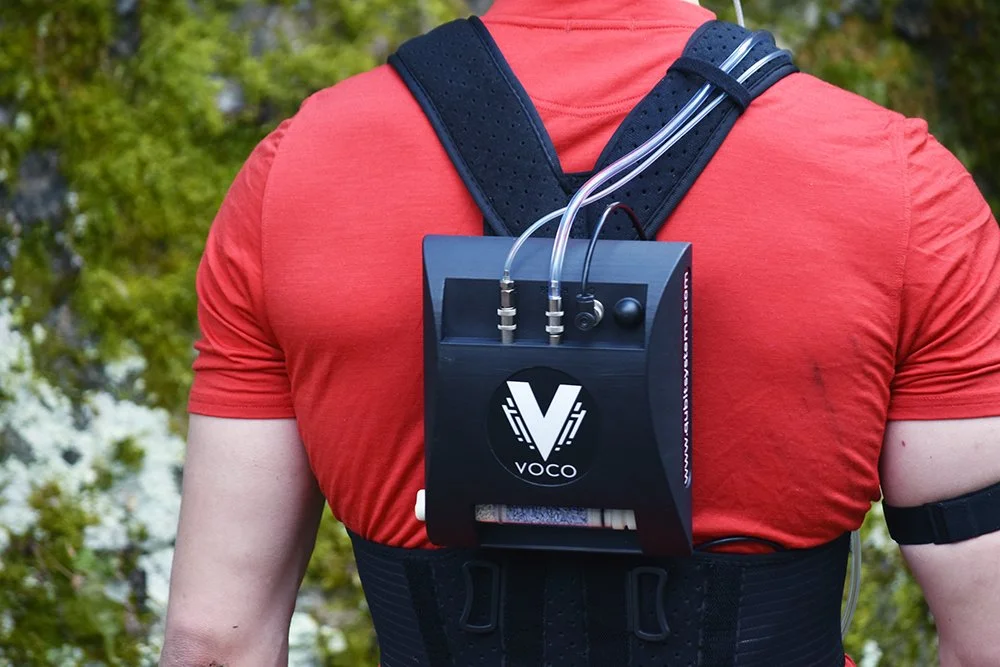
Qubit’s VOCO is a different proposition: an affordable, wearable, breath-by-breath cardiopulmonary exercise (CPX) testing system that measures both VO2max directly.
However, VO2max is not the only metric that determines a person’s fitness, and measuring O2 consumption alone misses more than half the fitness story. That is why VOCO also measures breath CO2. In this blog we’ll dig a little deeper into cardiopulmonary exercise testing and how this relates to fitness and health.
The Importance of VCO2
As well as consuming oxygen, metabolism of carbohydrates and fats produces carbon dioxide (CO2). The rate of CO2 production is termed VCO2. During aerobic metabolism of carbohydrates, one molecule of CO2 is produced for every molecule of O2 consumed. The ratio of CO2 produced to O2 consumed is called the respiratory exchange ratio RER). When metabolising pure carbohydrate RER = 1.0.
Fat molecules contain much less oxygen per unit carbon than do carbohydrate molecules. Therefore, during metabolism of fat, more oxygen is consumed than CO2 is produced. As a result, during metabolism of fat RER is typically about 0.7. By measuring VCO2 as well as VO2 during exercise a person can track when their body moves into fat-burning mode.
During exercise, if insufficient O2 is delivered by the bloodstream to the muscles to support energy demands, an anaerobic respiratory pathway of energy production is activated to supplement aerobic respiration. This pathway generates CO2 but does not consume O2. Therefore, during stressful exercise RER may begin to increase, and can rise above a value of 1.0.
Untrained individuals tend to exhibit anaerobic respiration much sooner during a given exercise regime than do trained athletes. By exercising regularly, the period of exercise can be extended before anaerobic respiration kicks in. The time taken to reach the anaerobic threshold is another indicator of fitness level.
In summary, by measuring O2 consumption and CO2 production simultaneously we can monitor:
VO2 and VCO2 as indices of fitness level.
The type of substrate being metabolised (carbohydrate or fat).
The point at which anaerobic respiration is activated to supplement aerobic respiration.
Monitoring Breath Dynamics and Heart Rate
A properly designed system for cardiopulmonary exercise testing should also incorporate methods for measuring heart rate, breathing frequency, breath volume, and end-tidal concentrations of O2 and CO2. The key parameters for fitness testing are listed in the table below:
Definitions of Key Parameters measured during Cardiopulmonary Exercise Testing.
For diagnostic purposes, these parameters are often plotted in a 9-panel Wasserman plot, such as that shown below:
Wasserman 9-panel plot generated by the VOCO analysis software.
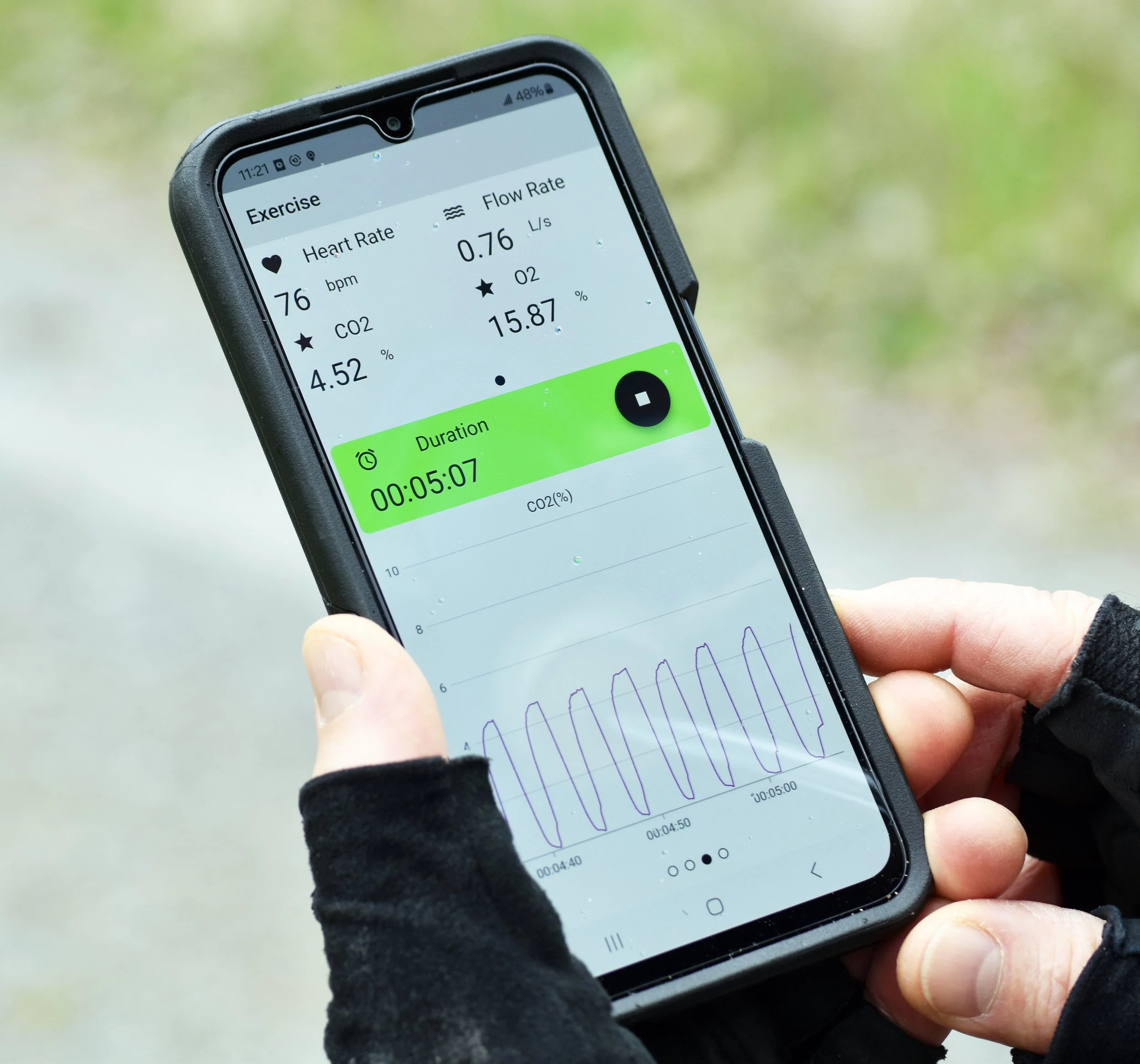
VOCO measures breath flow and tidal volume, respiratory rate, VO2, VCO2, RER, end-tidal O2 and CO2, and heart rate. Its desktop analysis software generates Wasserman 9-panel plots automatically.
But How Do I Know the Values are Accurate?
There are several methods by which the data obtained from a CPX system may be validated. These include combustion tests in which a known mass of ethanol, methanol or propane is burned and will, therefore, consume a known amount of O2 and produce a known amount of CO2. Such combustion tests are problematic because they provide limited information on the accuracy of CPX systems when used for high-intensity progressive exercise. Also, the method only assesses the accuracy of VO2 and VCO2, leaving other critical variables, such as VT and minute ventilation (VE) untested.
Many researchers believe that by paying a lot of money for a CPX system they are more likely to acquire one with better accuracy. Often, researchers insist that the data from inexpensive Product A be compared with that from expensive Product B to assess the accuracy of Product A. These cross-comparison studies between different CPX technologies are, frankly, rather silly, since they assume Product B is a ‘gold-standard’ and has no inherent measurement errors. If the devices produce different results, it is not known which is more accurate.
The validity of physiological variables measured via CPX is also influenced by the method used to determine flow/volume and gas composition. Recent studies showed significant discrepancies in accuracy among 15 commercially available CPX technologies. Therefore, using cross-comparative procedures to validate CPX systems is neither sensible nor reliable.
Based on the limitations stated above, international guidelines recommend the use of a metabolic simulator to effectively check the performance of CPX systems. Simulators offer reliable replication of human breathing at different frequencies and tidal volumes. Ideally, the respiratory and metabolic measurements such as VT, RR, VE, VO2, and VCO2 produced by a metabolic simulator should closely replicate those of human subjects.
The simulator maintains precise and consistent control over these variables, ensuring that each simulated breath within a given range of settings produces the same “respiratory” data, enabling highly accurate, reproducible, and precise testing of any CPX system. Therefore, the majority of recent studies validating and comparing CPX machines use metabolic simulators.
At Qubit, every VOCO is tested using a metabolic simulator, and the methodology and data are described in a white paper available on the VOCO website. VOCO also autocalibrates at a user-defined frequency, so accuracy is maintained as environmental conditions change.
What About Resting Metabolic Rate?
Good question. Resting metabolic rate (RMR) is important during cardiopulmonary exercise testing (CPET) because it establishes a baseline for understanding an individual’s metabolic and cardiorespiratory function. It is also used to determine the amount of energy (calories) the body requires to maintain basic physiological functions at rest. This is extremely important when exercise is used as part of a weight loss program. RMR can be very low in subjects that do not exercise, so weight gain occurs more readily with a given calorific intake. RMR tends to increase significantly after undertaking an exercise regime, so a person can consume more calories without gaining weight, or can lose more weight by dieting.
Measuring RMR may also help identify abnormal metabolic demands associated with chronic disease, deconditioning, or other physiological disturbances. For example, individuals with heart failure or COPD may have an elevated resting metabolic demand due to increased energy expenditure during breathing, sympathetic activation, or other physiological changes.
VOCO measures metabolism at rest as well as during exercise, making it a practical tool for establishing RMR and tracking how its value changes with training.
