
How can you trust a wearable CPX device for metabolic testing?

Whenever Qubit displays our wearable VOCO system at conferences, the two most common questions are: (a) How come it’s so less expensive than competing systems? and (b) Has it been validated? The latter question is often phrased as “has it been validated against [more expensive] System X? While the question may seem reasonable, it assumes that the higher price of System X must mean it is more accurate and trustworthy (you get what you pay for – right?). However, this is not necessarily the case.
Comparing one device's output against another’s, may reveal differences in the two datasets, but it doesn't tell you which one is right. The only way to determine which is more accurate is to compare each system with known CPX parameters generated by a metabolic simulator. That’s why each VOCO produced at Qubit is tested using such a device. It is to be hoped that our competitors do the same thing.
On measurement completeness
One problem with some lower cost metabolic measurement systems is that they measure O₂ consumption alone, whereas for full metabolic analysis you need to measure both O₂ and CO₂ exchange. VCO₂ data is not just nice-to-have, it is essential for monitoring respiratory exchange ratio, identifying the nature of metabolic fuel and determining the anaerobic threshold. Measuring O2 alone means you're missing more than half the metabolic picture.
Laboratory testing: capabilities and constraints
I want to be clear: the lab environment is essential for creating controlled conditions, repeatable protocols, and standardised testing. For many research questions, this is essential.
However, if you want to understand energy expenditure during actual sport performance — cycling a mountain trail, paddling a kayak at race pace, playing 90 minutes of football — you cannot replicate such activities in a lab. Dialling up the wattage on an ergometer isn't the same thing. The physiological demands, the movement patterns, the environmental variables — these can’t be simulated in the lab. For researchers interested in real-world metabolic performance, a wearable CPX system is essential, but selecting the one most fit for purpose can be a challenge. Cost is a factor, since some systems can be prohibitively expensive, but accuracy and the ability of the wearer to exercise naturally are the most important features. A device that restricts how an athlete moves is a device that changes what you're attempting to measure.
Instrument design and the field measurement challenge

The challenge with VOCO was straightforward in principle and demanding in practice: build a system with all the accuracy and capability of far more expensive metabolic carts and wearable systems, make it light and ergonomic so that it does not get in the way of natural movement, and make it accessible on price.
VOCO weighs 1kg and is worn on the back in a harness. It can be used indoors and outdoors. It measures both VO₂ and VCO₂, with automated calculations and instantaneous data visualisation through an app on your phone or tablet. A full desktop application handles post-exercise analysis and generates automated Wasserman 9-panel plots.
One technical challenge worth explaining is how we deal with temperature sensitivity. VOCO, like most wearable CPX systems, uses a fuel cell O₂ sensor — and these sensors are notoriously sensitive to temperature changes. Calibrate a unit at 22°C in the lab, take it outside in winter or on a hot summer’s day, and that calibration drifts. VOCO addresses this with periodic autocalibration.
At a user-defined frequency, the system samples ambient air for three seconds, compares the measured pO₂ and zero CO₂ against expected values, and adjusts its calibration coefficients on the fly. The entire process costs you one breath of data. The result is accurate measurements regardless of how the environment is changing around you.
Real-time data acquisition and practical applications
Having VO₂ and VCO₂ data available in real time isn't just convenient — it changes what's possible. An athlete training to stay below their anaerobic threshold can see exactly how close they are to anaerobiosis and can adjust their effort accordingly. A researcher targeting a specific submaximal VO₂ can confirm in real time that the subject has reached a specific level. You're not waiting until the session is over to find out what happened — you're making decisions during the tests.
Validation and accuracy
VOCO's accuracy has been fully substantiated through testing with a metabolic simulator — the correct methodology for validating a CPX device. A white paper is available on the VOCO website for anyone who wants to review the methodology and data in detail. At a price point under $20,000 USD, it is the only system at that cost we are aware of that delivers research-quality data equivalent to a metabolic cart.
For researchers and clinicians who have been working with a lab cart for years, VOCO is not a replacement, it is an extension. Everything you can do in the lab, you can still do. What changes is that your subjects are no longer restricted in the type of activities they can perform, inside or outdoors.
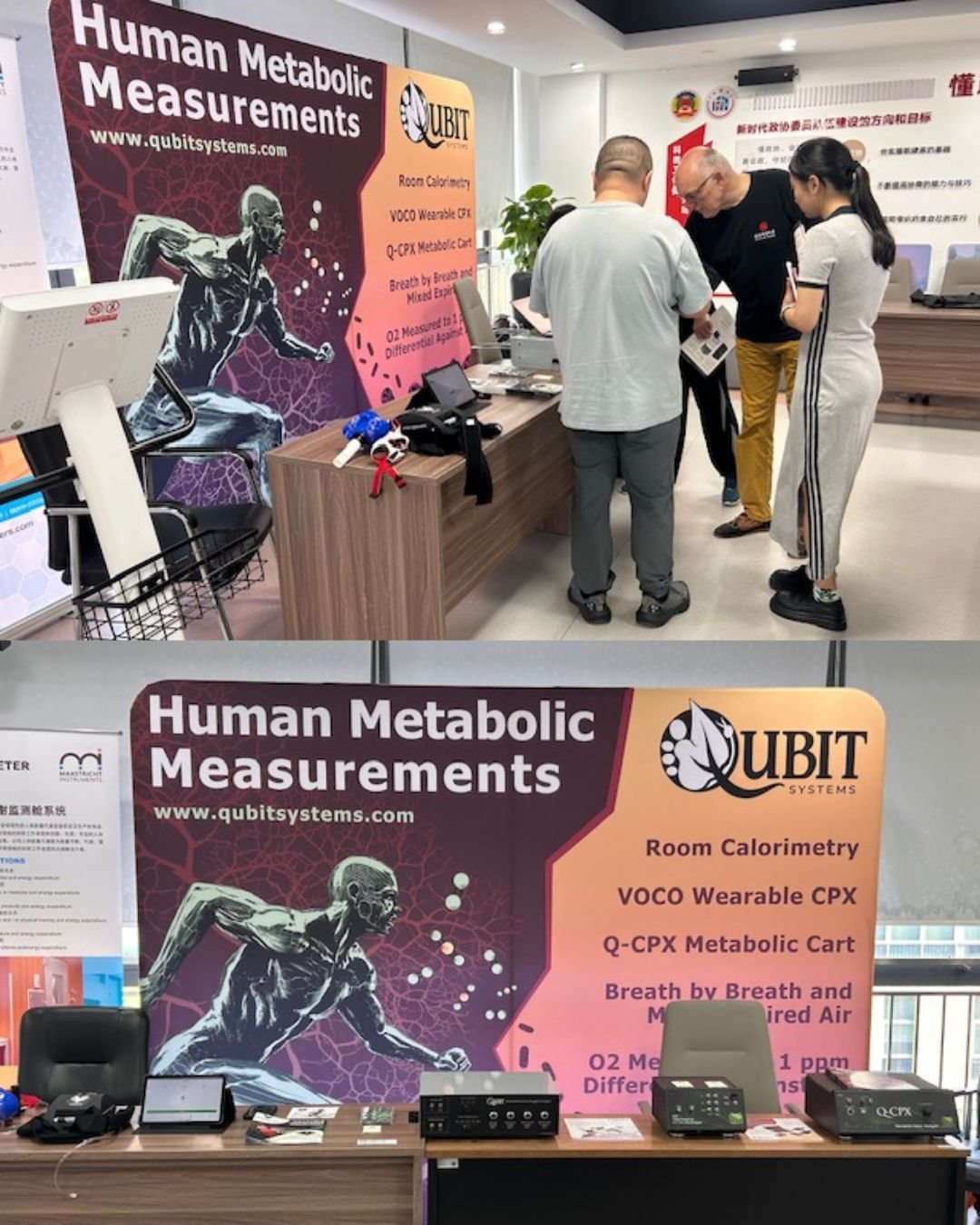
VOCO at ACSM 2026
We'll be at the American College of Sports Medicine Annual Meeting in Salt Lake City, May 26–29, and VOCO will be available for your inspection at booth #105. You can book a time to come and see us, maybe pop it on for a test, or just drop by and see data running on both the Android app and the desktop analysis platform.
We genuinely enjoy talking to sceptics as much as converts — so come with your hardest questions. If you can't make it to Salt Lake City, reach out to us directly. We’re always happy to connect over Zoom or Teams and walk through the system and its data with you.
VOCO CPX is developed by Qubit Systems. Learn more at voco-cpx.com or visit the Qubit Systems booth at ACSM 2026.
